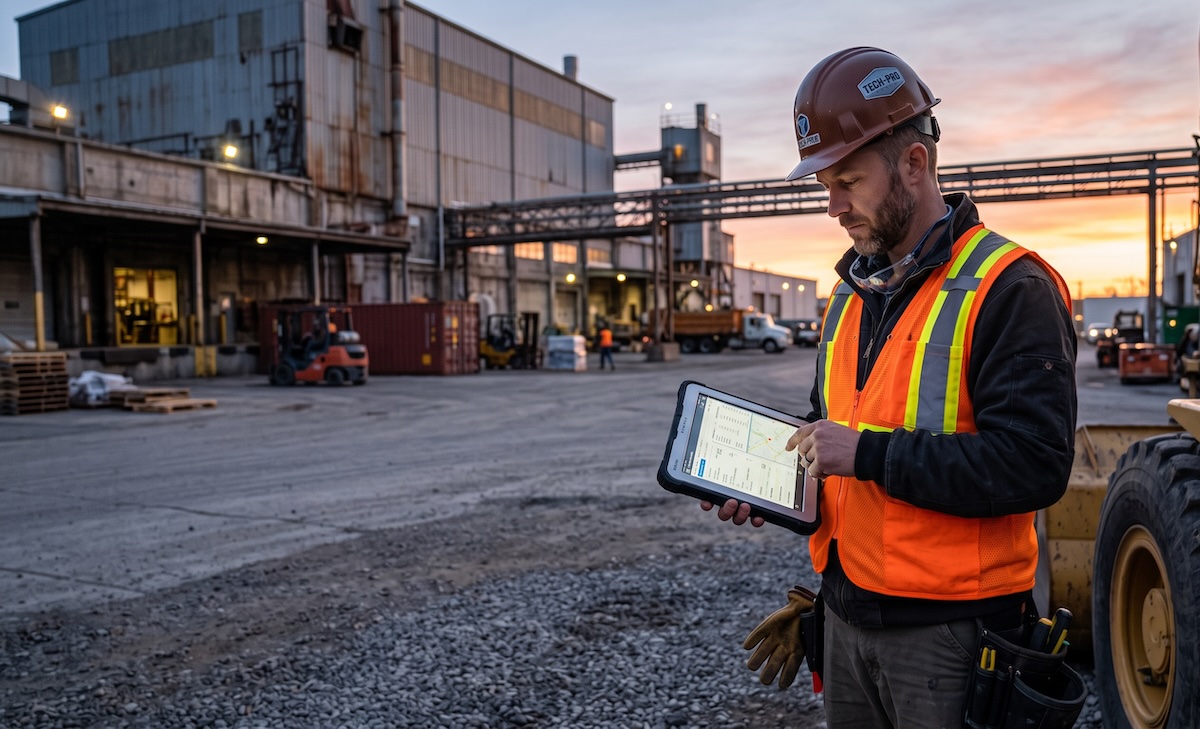
Field service organizations do not have a software adoption problem. They have a software fit problem. Generic enterprise platforms fail in trade and industrial environments because they were designed for office environments and retrofitted for the field. The physical conditions of the work make compliance with their documentation requirements functionally impossible.
Field service organizations do not have a software adoption problem. They have a software fit problem. The distinction matters because the two have entirely different solutions.
Generic enterprise platforms fail in trade and industrial environments not because technicians are resistant to technology, but because these products were designed for office environments and retrofitted for the field. The physical conditions of commercial and industrial work make compliance with their documentation requirements functionally impossible in the environments where the work actually happens.
A technician performing a fire suppression inspection in a mechanical room is working in low light, with both hands occupied, in a space not designed for comfortable equipment use. A rooftop HVAC technician on a summer afternoon in a jurisdiction requiring heat exposure protocols has approximately the same documentation conditions. A confined space entry governed by OSHA 29 CFR 1910.146, requiring a permit, an attendant, and real-time communication, does not create a window for tablet interaction. These are not edge cases. They are standard operating conditions across commercial field service work.
A mid-size mechanical contractor running 40 technicians across commercial accounts illustrates the pattern clearly. Their enterprise work order platform requires technicians to complete a 14-field service record at job close, including equipment serial capture, photo documentation, and supervisor sign-off. Completion rates in office-accessible locations run above 90 percent. In confined space entries and rooftop environments, completion rates drop below 40 percent. The platform is the same. The training is the same. The environment is not.
The documentation gap is consistently misread as a training failure. Technicians are not skipping work order completion, inspection checklists, and service verification because they lack instruction. They are skipping them because completing those fields requires conditions the job site does not provide. Retraining does not change the physical environment. It changes nothing.
The downstream cost surfaces in three places. Incomplete service documentation creates billing disputes on work that was performed, and work order gaps make those disputes difficult to resolve in the field organization's favor. In regulated environments including fire protection, elevator maintenance, and medical gas systems, documentation gaps during an inspection cycle are not administrative oversights. They carry defined regulatory consequence. Organizations that cannot capture what their technicians actually did, in what sequence, and under what site conditions cannot build the operational baseline that makes scheduling, parts forecasting, and workforce planning reliable.
The correct response is not to simplify the existing documentation interface. Simplification applied to a product designed for the wrong environment produces a simpler product for the wrong environment. The interface has to be designed around the physical reality of the work, not the conditions that exist at a desk.